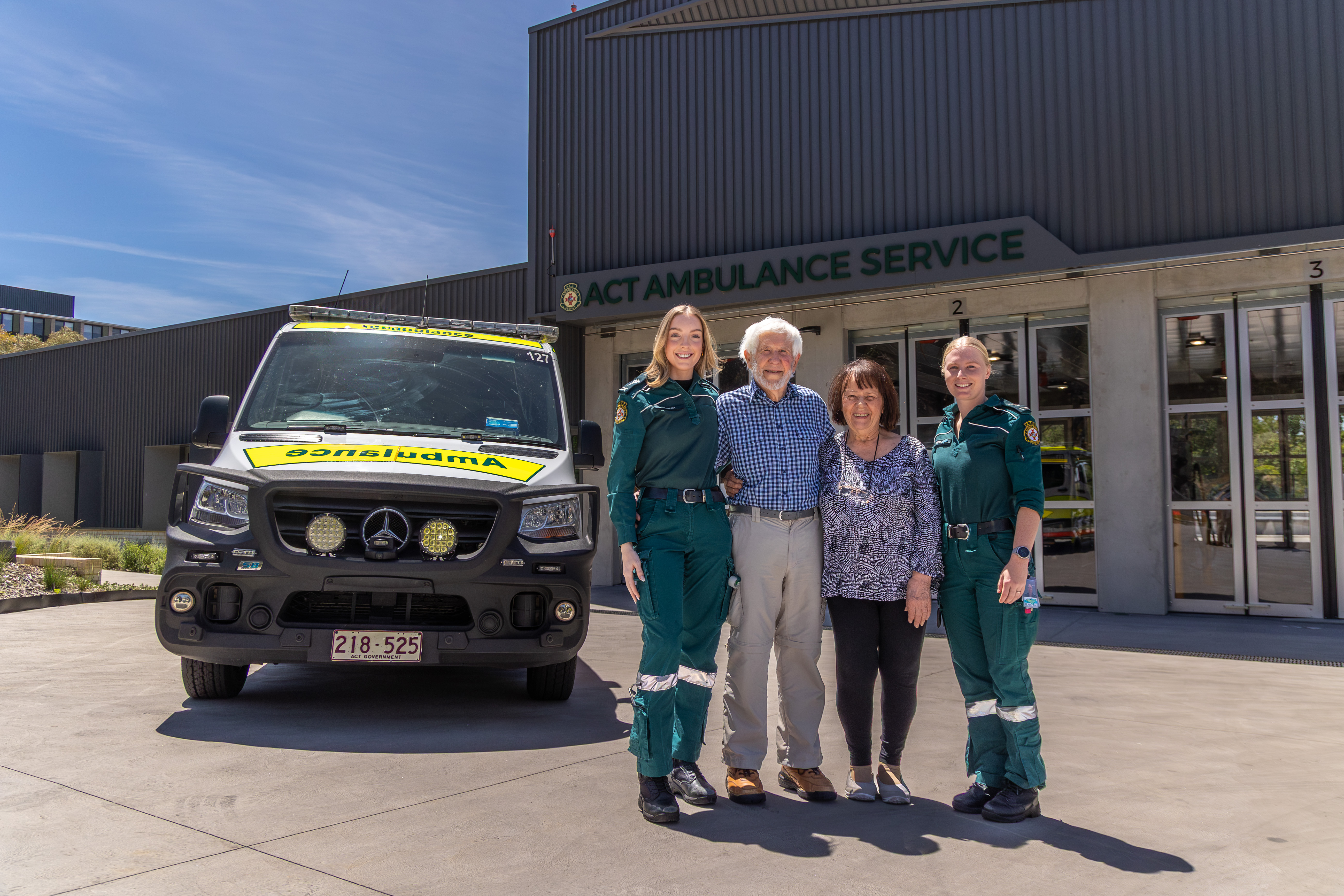
John never imagined that indigestion, and a vague feeling of fatigue, were the warning signs leading up to the most serious medical emergency of his life.
He had just welcomed a friend to his apartment for a coffee, when he suddenly felt unwell. He sat on the edge of his bed, overcome by nausea, and a tightening sensation in his chest.
Moments later, he was fighting to catch his breath.
“My friend took one look at my face and knew it was serious,” remembers John, “that was the giveaway.”
His friend immediately called Triple-Zero (000), and stayed on the line with the ACT Ambulance Service (ACTAS) Communications Centre, calmly answering questions and relaying crucial details about his symptoms.
As the call-taker collected this information, they quickly identified John's situation as life-threatening, and ensured the right level of response was sent as quickly as possible.
That early phone call, and the clarity of information provided, proved critical.
Emma, a paramedic who attended John’s incident, says the details received by the Communications Centre made an immediate difference.
“The information that came through suggested a very unwell patient - grey, sweaty, chest pain and vomiting,” she says.
“That early recognition of a critical case meant extra resources were already on the way to assist John, before we even arrived.”
When Emma and fellow paramedic Bridget reached John’s apartment, he was sitting on his bed, pale, clammy and clearly distressed.
The paramedics moved quickly, placing monitoring pads on John’s chest and performing an electrocardiogram, which confirmed he was experiencing a serious heart attack.
An intensive care paramedic was already en route, having been dispatched based on the information provided during the Triple-Zero (000) call.
Within minutes, the small bedroom became a tightly coordinated clinical space, with teams working seamlessly to stabilise John, and furniture moved aside, as the paramedics prepared to transport him to hospital.
Bridget says the response followed a clear, well-practised process.
“Once we identified how unwell he was, we managed him according to our treatment guidelines and activated the cardiac team,” she says.
“Everything then moves very fast – we provide treatment on scene, we ensure rapid transport, and the patient is delivered directly to the hospital’s catheter lab.”
John remembers little detail from the flurry of activity, but what stayed with him was the calm professionalism of the paramedics.
“Seconds mattered, and they didn’t hesitate,” he recalls.
“They cut my shirt straight off to get to my chest. That’s when you realise just how well-trained they are - nothing wasted, no time lost.”
In the ambulance, Emma stayed by John’s side, managing his condition, and reassuring him as they travelled to hospital.
Soon after arrival, doctors inserted stents to open his blocked arteries, restoring blood flow to his heart. The outcome was one John now describes as nothing short of remarkable.
“To be lying there afterwards, knowing I was alive because of their actions - it’s humbling,” he says.
“Without my friend, without the call-taker, without the paramedics, without the whole system working together, I wouldn’t be here.
“I'm also most fortunate to have all my family in Canberra, who are now supporting me on my post-cardiac recovery program.”
For Emma and Bridget, catching up with John weeks after the incident, and seeing him walking and talking again, was especially meaningful.
“We don’t often get to see a patient’s outcome,” Emma says.
“To see John back on his feet so soon after being critically unwell is incredible.”
Bridget agrees that being able to talk with a patient after an incident is very special.
“We have good days and bad days in this job,” she says, “but mostly good days.”
"This is one of those cases where our interventions were able to assist in the process of saving someone's life, and give him a second chance to continue on – and that just makes us so happy.”
John has since made it his mission to publicly thank ACTAS, and highlight the importance of providing accurate information to the Triple-Zero call-taker.
“People hesitate, or they second-guess themselves,” he says, “but that phone call sets everything in motion. It allows the system to decide what’s urgent and to get help where it’s needed most.”
ACTAS stresses that calls to Triple-Zero (000) are carefully triaged, ensuring that life-threatening cases like John’s take priority over non-urgent incidents.
Emma says that process is essential to achieving good outcomes.
“Not every job is the same, and resources have to be matched to how sick someone is,” she says.
“Early, accurate information helps our service make those decisions, and get critical care to the right patient at the right time.”
As John continues to recover, he says not a day goes by when he doesn’t think about the work being done by Canberra’s paramedics.
“These people see the worst moments of our lives, every day,” he says, “they’re unsung heroes.
“I’m living proof of what happens when the system works - and when someone makes that call without delay.”