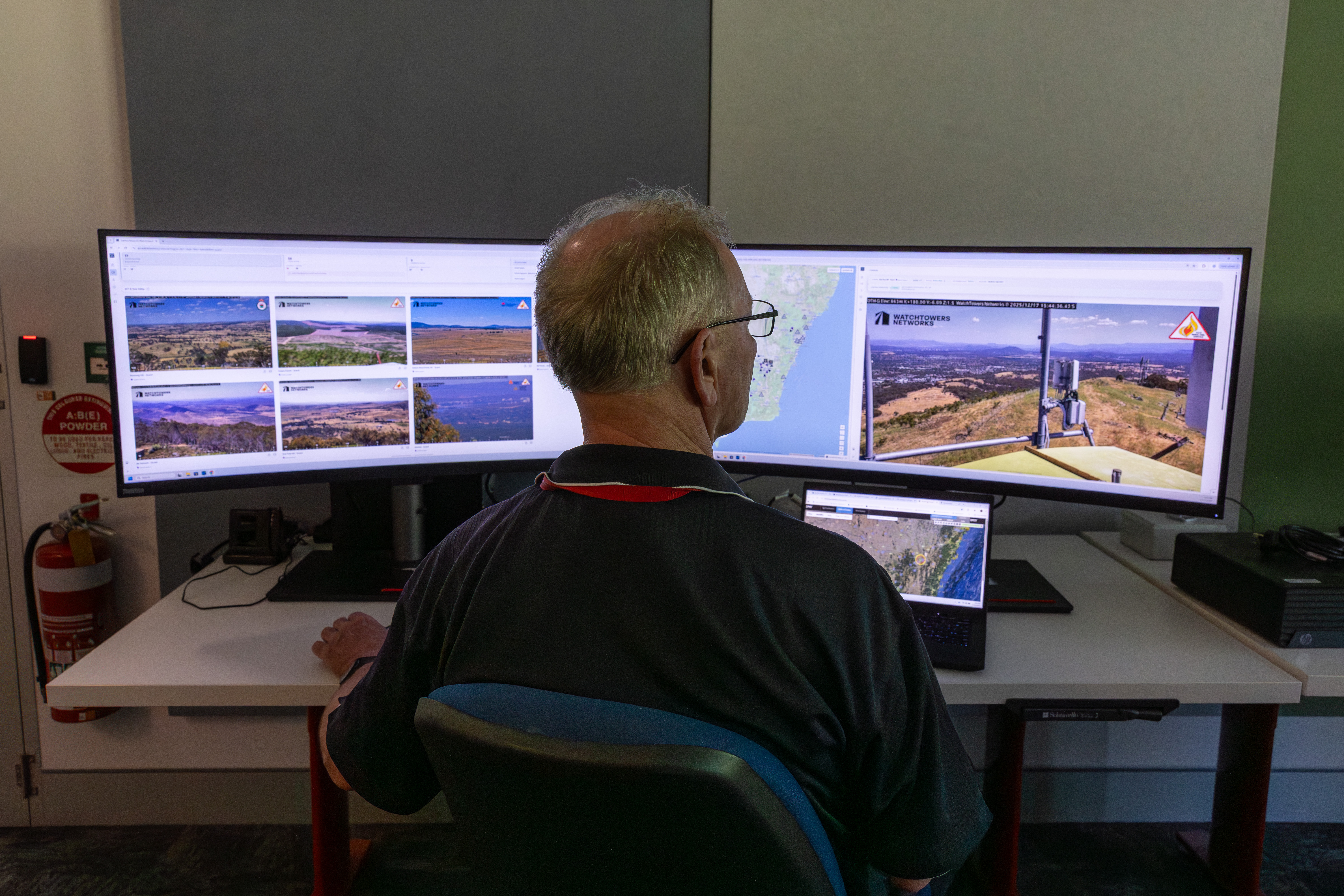
A sophisticated network of cameras on fire-towers is transforming the way bushfires are detected and assessed across the ACT.
What began as a safety initiative to reduce the risks for fire-tower operators from the ACT Rural Fire Service (ACTRFS), has evolved into an effective early-warning system - one that never sleeps.
The cameras, mounted on towers surrounding the ACT, provide a constant, sweeping view of the landscape.
Each tower is fitted with a rotating “guard” camera and a powerful “sentry” camera, which can be manually directed and zoomed to investigate anything of concern.
For Canberra, this means safer, quicker responses. The cameras allow remote operators to judge smoke colour, plume height, wind conditions, terrain and accessibility - all before a fire truck leaves a station.
ACTRFS Fire Tower Operator, Andrew Beer, says this early clarity avoids unnecessary callouts.
“We can zoom in and look at the size of the fire, what type of fire it might be, where it is, and how hard it is to get to,” he says.
“It’s really helpful to have those accurate details early.”
However, the benefits of the cameras extend beyond fire behaviour analysis. They help preserve the wellbeing of firefighters - most of whom are volunteers.
ACTRFS Chief Officer Rohan Scott says reducing fatigue and time spent away from families is a top priority.
“The technology means volunteers can be supported with real-time intelligence as they’re travelling to a job,” he says, “so they’ve got a very good picture of what they’re experiencing before they even arrive.”
Rohan says AI-assisted detection is also rapidly improving the service’s fire-management capability.
“The introduction of AI into the fire space has seen significant improvements in the way we detect fire, but also how we use that technology for intelligence gathering and real-time monitoring,” he says.
“It’s another tool in our toolbox, but it’s one we’re using more and more.”
Andrew agrees that the leap forward in AI-technology has been remarkable.
“As recently as last year, we had to have people in fire towers on high fire-danger days,” he says.
“Now, with the platform working 24/7, we can have an early notification of an incident, without having a human being out there all day and all night.
“The AI is always there. It’s never asleep, and it’s the first port of call to identify fire incidents.”
With AI analysing camera feeds in real time, it can distinguish between smoke, dust, steam, or other landscape changes. Rohan says the system has improved dramatically over a short period of time.
“When we first introduced the technology, it was indicating pockets of dust, even picking up sunrise and sunset every day,” he remembers.
"But as the system has learnt, through our people confirming or denying incidents, we’re now not getting as many false sightings. It’s far more accurate, and that reduces our resource effort.”
Even with the rapid evolution of AI, Rohan is adamant that the technology is designed to support, not replace, people.
“We are always going to need firefighters on the ground - they’re the ones who physically put the fires out,” he says.
“AI is a tool that gives us reassurance and confirmation of our decisions.
“It’s increased our knowledge and our ability to keep our people safe.”